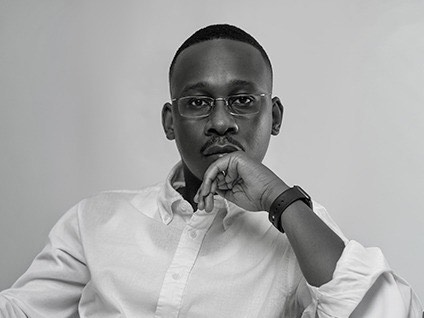
Eusébio Sanjane

Eusébio Sanjane is one of the most promising figures in contemporary Mozambican literature. He holds a degree in Political Science from Eduardo Mondlane University and a master’s degree in Strategic Human Resource Management from the Polytechnic University. He has pursued a multidisciplinary career, combining writing, museology, and art curation. He is originally from the historic Chamanculo neighborhood in Maputo.
In addition to having his work featured in newspapers, literary magazines, and anthologies in Mozambique, Brazil, Chile, Italy, and Spain, he is the author of the novel Arquivo Morto: As cartas da guerra que não acabou (Lisbon: Astrolábios Editora, 2025); and the poetry books Anatomia do Vazio (Maputo: Estação 8, 2025); Frenesim: Poesia em Pétala de Lume (Maputo: Ndjira, 2014); and Rosas e Lágrimas (Maputo: Ndjira, 2006). He is a member of the Mozambican Writers’ Association (Associação Moçambicana de Escritores – AEMO), the União Nacional dos Escritores, and a correspondent for the Casa do Poeta Brasileiro. In 2025, he was awarded the Imprensa Nacional/Casa da Moeda/Eugénio Lisboa Prize for his unpublished novel As 12 Caixas do Império.
THE WEIGHT OF IVORY (O PESO DO MARFIM)
Mozambique, 1880. António Soares lands in Quelimane with a simple dream: to get rich in the ivory trade and return to Portugal covered in glory. But Mozambique has other plans. Amélia, a Mozambican woman of breathtaking beauty, steals his heart. She gives him a son. She teaches him that there are fortunes that cannot be measured in pounds of gold. Then tragedy strikes: Amélia dies of malaria. Mário, her seven-year-old son, disappears on a moonless night. António searches for him for twenty years. Twenty years scouring the entire continent, bribing informants, following false leads. Until the truth — when he finally finds it — is worse than all the lies.
His son is alive. He has become the ruthless leader of the anti-Portuguese resistance. He was raised to hate everything his father represents. And it was Sampaio who transformed him into this warrior — the mentor António trusted most, the man who taught him how to survive in Africa, who has now chosen Africa over Portugal. Father and son face to face. Two sides of the same war. “I buried the boy I was the night they took me away,” says Mário. “I can’t resurrect him.” Between love and loyalty, between fatherhood and betrayal, António faces the devastating question: can the unforgivable be forgiven when blood calls for blood? An epic novel about how History shatters families and forces good men to make impossible choices.

Status/Publication: Unpublished.
THE 12 BOXES OF THE EMPIRE (AS 12 CAIXAS DO IMPÉRIO)
Lisbon, Torre do Tombo. Twelve boxes have lain dormant for fifty years in a secret archive. Inside them, the evidence of crimes Portugal doesn't want to remember: documents from a military commission that investigated torture by the colonial police (PIDE) in Mozambique and was silenced before revealing the truth. The State buried the dead. And buried the evidence. London. Kalid Mussá, a doctoral student in History, reads a news article and his world crumbles: his grandmother, who died "of illness," was sold to the PIDE by someone from her own family. An informant with the initials A.M. betrayed her for months, word by word, secret by secret, until they saw her leave in a van with no return. Now, Kalid needs to know who.
The answer lies in Mozambique, in the memories that the family has silently preserved. And it's worse than he imagined: A.M. is Alberto Mussá — the great-uncle who raised him as a son, who paid for his studies, who built a business empire on his own sister's grave. Fifty years of lies. Fifty years of guilt disguised as generosity. But someone doesn't want the truth to come to light. Former PIDE agents begin to die. The boxes are sabotaged. And Kalid realizes that this was never about the past — it's about a present where the ghosts of the empire still kill to keep the secrets buried. A chilling thriller about the crimes that nations hide and the families that protect them. Winner of the Imprensa Nacional/Casa da Moeda/Eugénio Lisboa Prize in 2025.

Status/Publication: Unpublished.